A Practical Map of Boston Municipal Career Routes
Separate the employer, hiring pathway, and evidence you need before investing in an application.
Read the guide ↗A CAREER IS A SERIES OF REAL QUESTIONS
The title is only the beginning. Understand the service, compare the role, and assemble evidence you can stand behind. A practical independent guide to researching work with the City of Boston.
Independent of the City of Boston. No job matching, applications, login or official employee support.
Access Boston is a City workforce sign-in context, not a destination for this publication’s readers to enter credentials. Our public resource guide explains how it fits alongside other official routes and where to confirm your next step.
Read the longer guides first, then follow the questions that match the role you are researching.
Separate the employer, hiring pathway, and evidence you need before investing in an application.
Read the guide ↗Turn a long posting into a clear map of duties, requirements, working conditions, and questions.
Read the guide ↗Connect role criteria to specific actions, supportable results, and clear limits before drafting.
Read the guide ↗Use service tasks, working conditions, and evidence to build a realistic municipal-career shortlist.
Read the guide ↗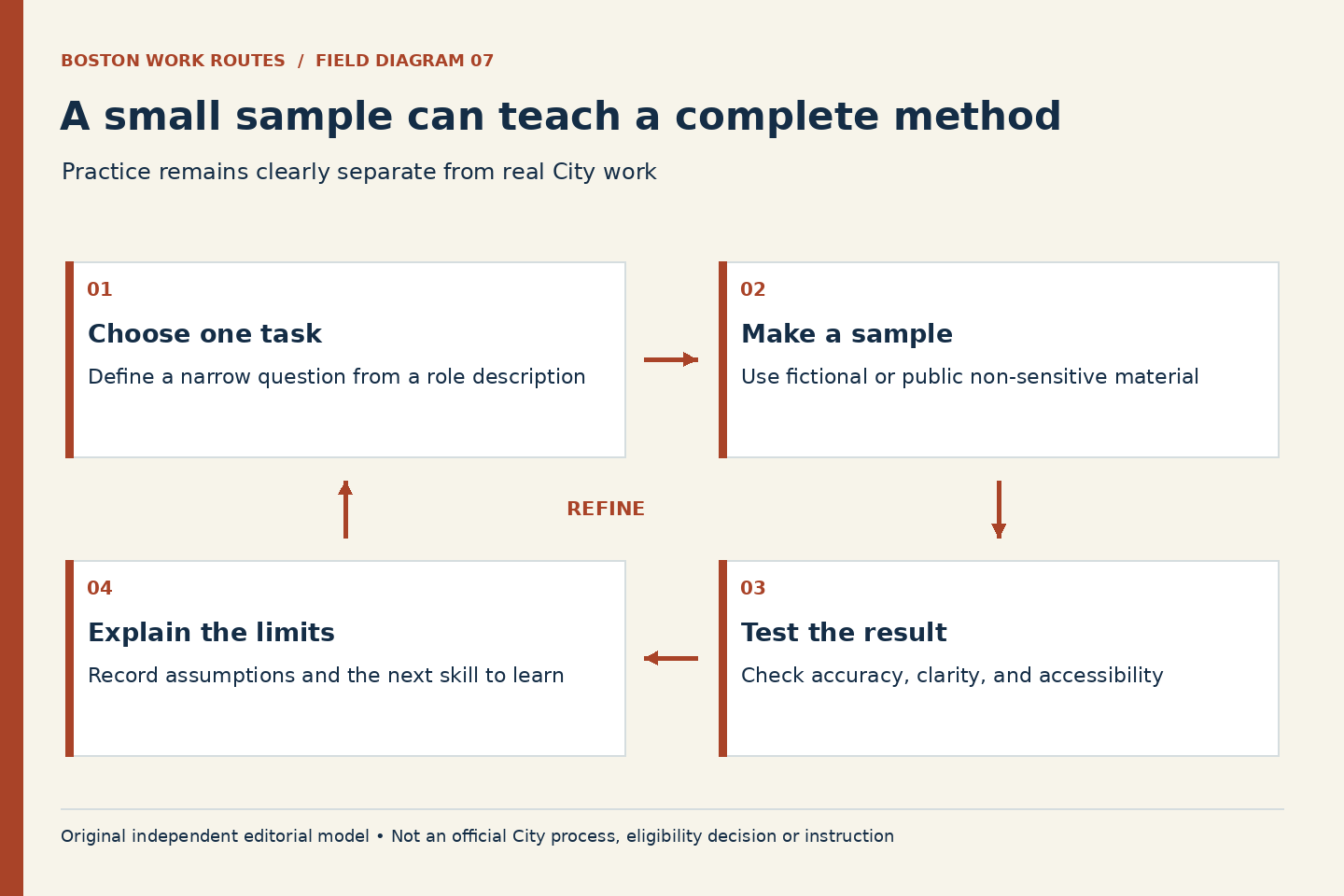
MAKE THE METHOD VISIBLE
Use a focused six-week cycle to understand a role, practice relevant tasks, and produce honest evidence of learning.
Explore the method →Role Route Planner
Select a research task and a stage. Get a practical next-step card grounded in the official source. Your selection stays in this page; no account, upload, or personal details are needed.
Useful output: A one-page route card with a verified next destination
Scope limit: This planner organizes research; it does not find live vacancies or decide eligibility.
Useful output: A posting map that distinguishes facts from unanswered questions
Scope limit: Only the hiring employer can interpret its requirements or confirm appointment terms.
Useful output: A criterion-to-evidence worksheet ready for drafting
Scope limit: Do not enter personal records here. The tool accepts no uploads and evaluates no qualifications.
Useful output: A two-role comparison with an explicit uncertainty list
Scope limit: The output is a research aid, not a recommendation to accept employment or relocate.
Useful output: A route-specific action log tied to official notices
Scope limit: This is a navigation checklist, not a legal interpretation, rank calculation, or selection forecast.
Useful output: A dated program brief and preparation checklist
Scope limit: Observed on October 2, 2026: the cited City summer internship page marked its 2026 cycle closed. Recheck future announcements.
Useful output: A bounded learning plan with one reviewable practice artifact
Scope limit: A self-directed project is not a City-approved credential and does not replace a required license or qualification.
Useful output: A checked packet and a factual submission record
Scope limit: This local tool does not submit, store, or transmit applications and cannot inspect application status.
Fixed public-source reading aid, checked October 2, 2026. Choices exist only in this page’s memory. No tool storage, cookies, uploads, URL parameters or network requests. Your browser may restore form state independently. Never enter private records or credentials.
Different responsibilities, entry routes and evidence needs. Browse all 18 guides or filter by topic.
18 articles
Career Routes
Separate the employer, hiring pathway, and evidence you need before investing in an application.
Read the article : A Practical Map of Boston Municipal Career RoutesApplication Workshop
Turn a long posting into a clear map of duties, requirements, working conditions, and questions.
Read the article : Read a City Job Description in Five Useful LayersApplication Workshop
Connect role criteria to specific actions, supportable results, and clear limits before drafting.
Read the article : Build an Application Evidence Workbook That Stays HonestRole Explorer
Use service tasks, working conditions, and evidence to build a realistic municipal-career shortlist.
Read the article : Choose a Public-Service Role by the Work You Want to DoCareer Routes
A notice-by-notice planning method for Boston roles that use a state-linked hiring route.
Read the article : Civil Service and Labor Service: Keep the Hiring Stages SeparateCareer Routes
Prepare a focused conversation about role-specific residency requirements without making assumptions.
Read the article : Residency Questions to Clarify Before a Boston Job ApplicationCareer Routes
Read cycle status, project work, and application requirements before preparing for a named program.
Read the article : Research Boston Internships and Fellowships by Program CycleRole Explorer
Understand a team’s services and the role’s contribution without pretending to have insider knowledge.
Read the article : Build a One-Page Brief on a Boston DepartmentCareer Routes
A source-first guide to separating job applications from employee-resource access.
Read the article : Career Center or Access Boston? Choose the Right Starting PointSkills Studio
Turn scattered experience into a private, truthful inventory you can use to evaluate municipal roles and prepare application materials.
Read the article : Build a Skills Evidence Inventory Before You ApplyApplication Workshop
Use actions, service context, and supportable outcomes to make relevant experience clear without inflating your role.
Read the article : Write Municipal Resume Bullets That Show the WorkApplication Workshop
Review completeness, consistency, readability, and privacy before sending application materials for a municipal role.
Read the article : Give Your Application Materials a Final Quality CheckApplication Workshop
Develop specific examples of judgment, service, collaboration, and learning without memorizing speeches or inventing outcomes.
Read the article : Prepare Public-Service Interview Stories With Clear BoundariesRole Explorer
Build an evidence-based comparison of two postings, separate unknowns from preferences, and decide what to investigate next.
Read the article : Compare Two Municipal Roles Without Inventing a WinnerSkills Studio
Use a focused six-week cycle to understand a role, practice relevant tasks, and produce honest evidence of learning.
Read the article : Build a Six-Week Municipal Career Learning PlanSkills Studio
Rehearse clear explanations, respectful handoffs, and communication boundaries for roles that interact with residents and visitors.
Read the article : Practice the Judgment Behind Community-Facing WorkSkills Studio
Create a small, inspectable portfolio that shows your methods, testing, and limitations using safe illustrative materials.
Read the article : Build a Technical Portfolio Without Exposing Private WorkApplication Workshop
Keep a private, evidence-based application log that separates your actions, employer messages, and unresolved questions.
Read the article : Track Applications Without Guessing What the Status MeansTHE EDITORIAL STANDARD
Boston Work Routes adds original planning methods, labeled hypothetical examples and diagrams to current public-source research. Source-check dates are visible so a reader can distinguish the reviewed source from a promise of continuing accuracy.
No invented employees, interviews, professional reviews or testimonials. This collection was prepared with automated assistance. Responsible publisher: mike bravos.